CardiaQ: Quantum Algorithms for the ECG Diagnostics of Tomorrow
The CardiaQ research project explores how quantum machine learning, based on a unique combination of real and high-precision synthetic ECG data, can improve the detection of rare heart diseases.
Reliably detecting rare heart diseases using quantum algorithms
Cardiovascular diseases are the leading cause of death worldwide: around one in three deaths is attributable to them. The electrocardiogram (ECG) is the most important non-invasive diagnostic tool in cardiology. Every year, more than 300 million ECGs are recorded worldwide. The CardiaQ research project (Cardiac Analytics and Recognition using Deep Intelligence and Quantum algorithms) investigates how quantum machine learning (QML) can improve the automated analysis of multi-channel ECGs, especially for rare and subtle heart conditions. These conditions are particularly challenging to detect because real data on them is scarce. CardiaQ tackles this challenge on two levels: high-precision synthetic ECGs from patient-specific heart simulations expand the database with targeted rare pathologies. At the same time, initial research results suggest that QML models can learn complex patterns in a particularly data-efficient way. This combination aims to take the detection of rare ECG anomalies to a new level.
CardiaQ: Quantum-based ECG diagnostics of the future
Project goals: From heart simulation to quantum-based diagnostics
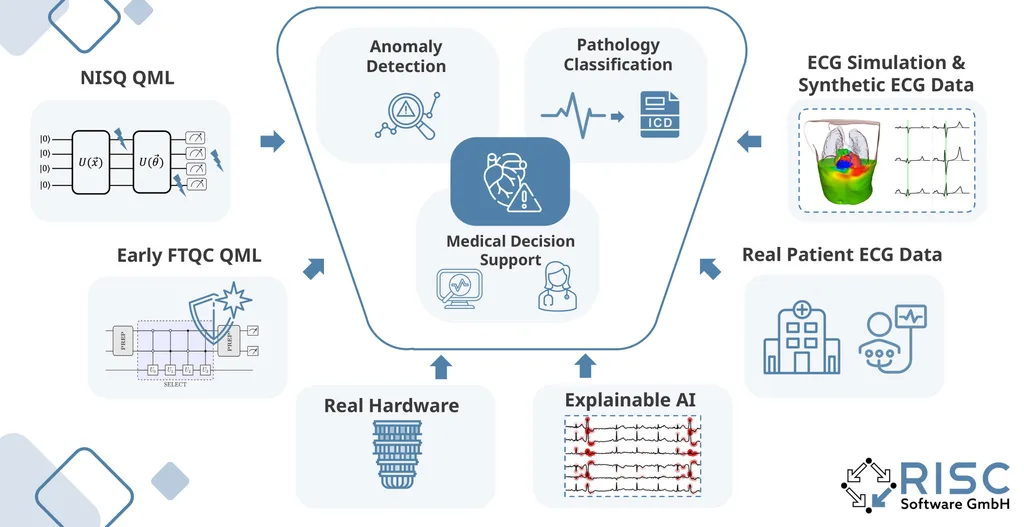
Realistic synthetic ECGs: Using purposefully enhanced electrophysiological heart simulation software, the project creates more than 30 virtual heart-torso models of healthy and diseased individuals covering more than five different pathologies. A panel of cardiologists assesses their clinical realism. The bar is high: at most one in ten synthetic ECGs should be recognisable as synthetic.
Hybrid quantum AI for today: The project develops hybrid models that combine classical machine learning with quantum algorithms and already run on today’s quantum computers (NISQ). The spectrum ranges from neural networks with integrated quantum layers and quaternion-based model architectures to quantum reservoir computing.
Quantum algorithms for tomorrow: Looking ahead to future fault-tolerant quantum computers, the project also develops novel trainable quantum models. They build on advanced algorithmic building blocks such as Quantum Linear Algebra, Quantum Hypercomplex Algebra and Quantum Singular Value Transformation.
Explainability and real-world testing: The team systematically benchmarks all quantum models against classical deep learning models to assess their added value objectively. A particular focus lies on transparent, clinically interpretable decisions. The team also evaluates selected models on real quantum computers.
Long-term vision: Strengthening Austria’s innovative power in key technologies
CardiaQ brings together leading experts in quantum computing, artificial intelligence, heart simulation and clinical cardiology. This interdisciplinary collaboration between RISC Software GmbH, JOANNEUM RESEARCH, Fraunhofer Austria, the Medical University of Graz and NumeriCor GmbH strengthens Austria’s technological sovereignty in these crucial fields of the future. In the long term, the project thus lays the foundation for a new generation of ECG diagnostics.
Building on successful previous projects
CardiaQ builds on many years of experience at RISC Software GmbH at the intersection of AI, quantum computing and medicine. The QML4MED project explored the clinical innovation potential of quantum machine learning, including with medical time series signals. The fundamental research project QuditML extends QML approaches to multi-level quantum systems. Insights from the AIMS and Heart projects, which use ECG time series for the AI-based prediction of health deterioration, also feed into CardiaQ.
This project is funded by the FFG (www.ffg.at). The FFG is the central national funding organisation and strengthens Austria’s innovative power.
Project partners
Project details
Project short title: CardiaQ
Project full title: Cardiac Analytics and Recognition using Deep Intelligence and Quantum algorithms