
More Than Just 0s and 1s: How Qudits Are Opening Up New Paths in Quantum Computing
By DI Philipp Moser, PhD
Quantum computing is considered a promising new computing paradigm that is expected to enable new forms of information processing through quantum mechanical effects such as superposition. What is less well known is that many quantum systems go beyond the familiar qubit with its two states and can utilize more than just two states: These so-called qudits open up new possibilities for more compact data encoding, more expressive models, and potentially more efficient quantum algorithms.
Contents
- Quantum Computing as a New Computing Paradigm
- After 0 and 1 come 2, 3, …
- Between Theory and Practice: The Untapped Potential of Qudits
- FWF Project QuditML: The Quantum Algorithms of Tomorrow
- References
- Author
- Read more

Quantum Computing as a New Computing Paradigm
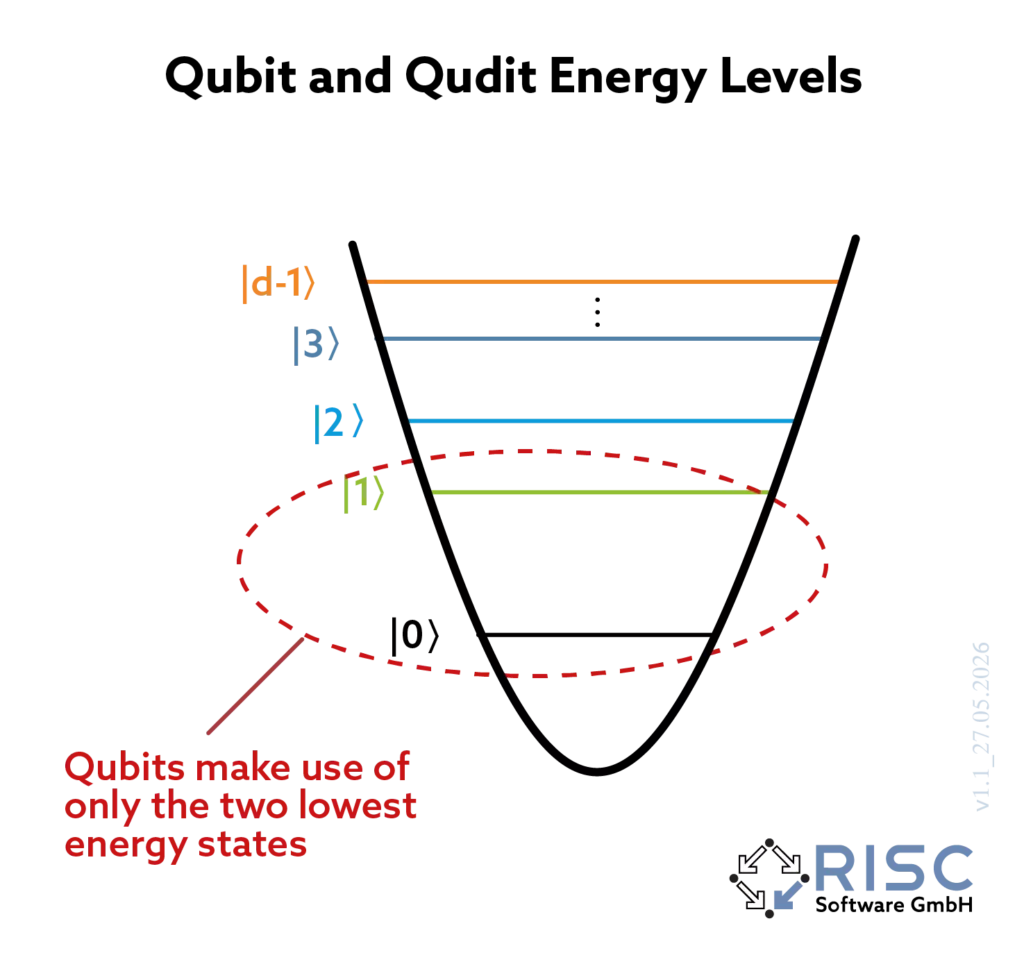
When people talk about quantum computers, the term “qubit” almost always comes up first. Qubits are the quantum mechanical analog of classical bits in conventional computers and can not only assume the states 0 and 1, but also exist in a superposition of both; see Figure 1. It is precisely these quantum mechanical superpositions that form, among other things, a central foundation for the potential of quantum computing, because they enable novel forms of information processing that go beyond classical computing concepts. A key research area in quantum computing is optimization problems, in which the goal is to find good or optimal solutions as efficiently as possible within very large search spaces. Furthermore, quantum computing is also considered promising for quantum machine learning—a fusion of quantum computing and machine learning—as well as for the simulation of quantum systems, for example in materials and drug discovery research.

After 0 and 1 come 2, 3, …
What is less well known is that most quantum computers have more than just these two usable states. Qudits are a generalization of the qubit concept to d states. While the “b” in qubit stands for binary two-state logic, the “d” in qudit refers to d-dimensional—that is, a multi-level quantum system with more than two usable states. A qutrit, for example, has three states. These additional levels are already present in many physical platforms, such as higher energy levels in superconducting or ion-based quantum systems. The central idea is therefore obvious: Why leave these additional states unused if they could potentially be used for more efficient computational algorithms?
Between Theory and Practice: The Untapped Potential of Qudits
A key advantage of qudits is that they allow for a higher information density per quantum system than qubits. This could enable data to be encoded more compactly and more expressive quantum machine learning models to be developed for certain problems. At the same time, the higher number of states opens up the possibility of solving certain tasks even with smaller system sizes. This is of particular interest when considering real-world hardware, because smaller quantum systems are potentially easier to implement than ever-larger qubit-based architectures. The theoretical advantages of such multi-level qudit systems have already been well documented and analyzed in the literature [1,2]. However, translating this potential into concrete and practically usable quantum algorithms is still in its early stages.
FWF Project QuditML: The Quantum Algorithms of Tomorrow
These are precisely the questions we are addressing in the FWF-funded research project QuditML [3,4]. The goal of QuditML is to bridge the gap between the theoretical potential of qudits and practical applications. To this end, we are developing novel qudit-based machine learning algorithms, designing suitable data encodings for tabular, signal-based, and image-based data, and evaluating their practical utility for applications in medicine, high-energy physics, and chemistry. In this way, the QuditML project could serve as a catalyst for more intensive research into multi-level quantum computing, advance quantum technology as a whole, and thus bring us one step closer to a new generation of powerful and practical quantum algorithms.
References
[1] https://arxiv.org/abs/2505.05158
[2] https://arxiv.org/abs/2008.00959 Wang Y, Hu Z, Sanders BC, and Kais S (2020) Qudits and High-Dimensional Quantum Computing. Front. Phys. 8:589504. doi: 10.3389/fphy.2020.589504
[3] https://www.fwf.ac.at/forschungsradar/10.55776/TAI1354725
Contact us
Author
DI Philipp Moser, PhD
Senior Researcher & Developer