The importance of outcome in the value generation of software products.
by DI (FH) Andreas Lettner
The evaluation of software products is traditionally based on different levels: Input, Output, Outcome and Impact. These levels are closely linked and play a key role in generating the value of a product. In practice, there is often a focus on input and output, while the importance of outcome is neglected. This report examines the interdependence of these levels and emphasizes the relevance of an outcome-focused approach.
Contents
What are input, output, outcome and impact?
Why not output?
How can you work in an outcome-focused way?
Additional support through a purpose
Conclusion
Author
What are input, output, outcome and impact?
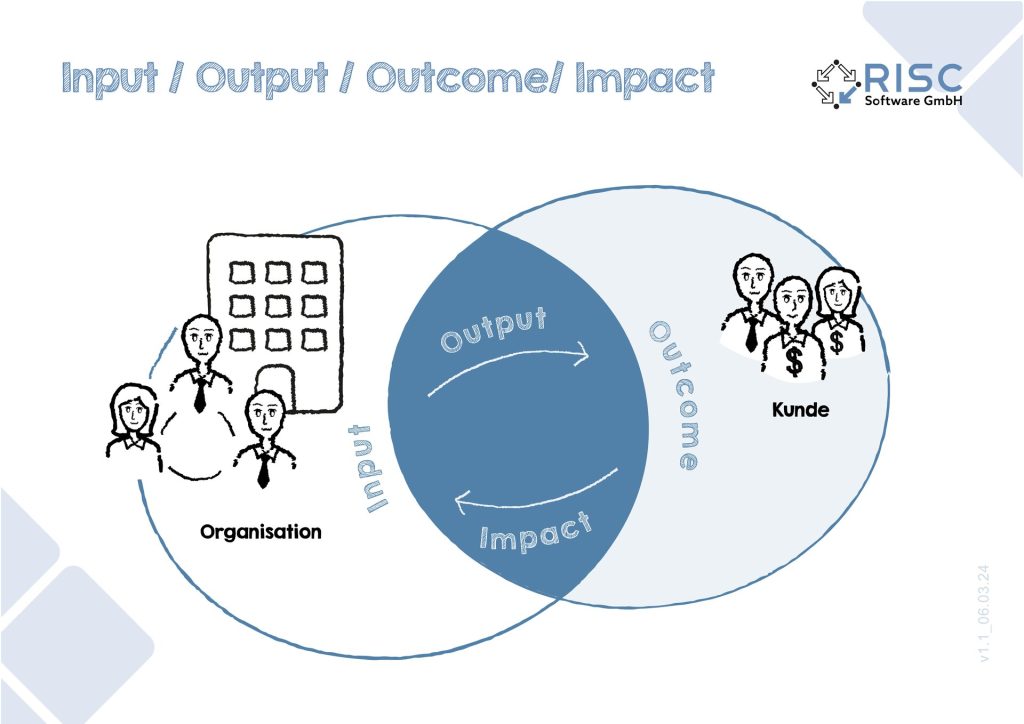
Input is the amount of resources invested in the development of a software product, including time, money, expertise and technology. Metrics such as development time, budget allocation, team size and technical complexity can be used to measure the input level.
Output describes the direct results of the development activities and refers to the characteristics of the product and the services that are created or provided. Metrics such as the number of functions developed, number of lines of code, number of errors and scope of documentation can be used here.
Outcome, on the other hand, refers to the actual changes (including behavioral changes) or improvements that a product brings about among users or in the environment. Metrics such as user satisfaction, user acceptance, frequency of use, conversion rates, time savings and efficiency gains can be used to measure the outcome.
Finally, impact refers to the long-term consequences or effects of the product on the entire organization, industry or society. Metrics such as sales increases, cost savings, market share gains, innovations or customer loyalty can be used here.
Why not output?
Although a focus solely on output is a good argument for evaluating productivity, it is not expedient. Output metrics only quantify the immediate results of development activities without considering the actual impact on users or the environment. While these metrics can provide important information about what was produced, they say nothing about the quality, usefulness or long-term benefits of the product. Without a focus on outcome, there is a risk that companies will develop products that are feature-rich or technically sophisticated, but ultimately fail to meet the needs of users or bring about the desired change. This can lead to bad investments, low user acceptance and a lack of competitiveness as products do not meet the actual needs of the target group. It is therefore important that companies take a holistic approach that considers not only the generation of output, but above all the achievement of the desired outcome and long-term impact.
How can you work in an outcome-focused way?
An outcome-focused approach means that the emphasis in product development is placed on the actual benefits and added value for users. This approach requires continuous evaluation and adjustment of the product to ensure that it delivers the desired results. Unfortunately, this approach is often neglected in practice as organizations often focus on product development and deployment without adequately considering the long-term impact on their users or the environment.
Agile methods provide a framework that facilitates a focus on outcome. Through iterative development cycles and close collaboration with stakeholders, including the ultimate users, agile methods enable continuous validation and adaptation of the product based on the actual benefits and needs of the users. The integration of users into the development process makes it possible to collect feedback at an early stage and ensure that the product delivers the desired results.
Evidence-Based Management (EBM) is another approach that can support the development of software products. EBM refers to the use of empirical data and validated findings to make decisions in the management process. This means that decisions should be based on existing evidence rather than assumptions or personal opinions. By applying EBM, companies can make more informed decisions and minimize risks by building on actual data and experience.
Additional support through a purpose
The close connection between outcome and purpose is a key aspect in the value generation of software products. The purpose, i.e. the purpose or intention of the product, is crucial in order to be able to clearly define the desired outcome. A clearly defined purpose helps to focus on the creation of a purpose-oriented outcome.
If there is a lack of consistency here, this can lead to inefficiency, misalignment of the product and a lack of acceptance on the part of users. It is therefore important that companies clearly and explicitly define the purpose of their product and ensure that the intended outcome corresponds to this.
Conclusion
A focus on outcome is crucial for the value generation of software products and the long-term generation of impact. It enables companies to ensure that their products actually deliver the desired improvements for users and the environment. By focusing on outcome, companies can achieve long-term positive impact that goes beyond short-term output metrics. If companies focus solely on input and output, they risk losing sight of the actual benefits of their product and thus miss out on long-term impact. An outcome-focused approach allows companies to continuously improve their products by addressing the actual needs and requirements of their users, thus creating long-term positive impacts on the organization, the industry and society as a whole.
Ansprechperson
Author
DI (FH) Andreas Lettner
Chief Product Officer, Head of Unit Domain-specific Applications