The aim of AIMS is to develop and validate an early warning system using artificial intelligence to warn of deteriorating conditions on the ward before they occur.
Medical motivation
Surgical procedures are safer today than ever before. Nevertheless, the risk for patients remains high. In Europe, an average of 4% of all people undergoing surgery die in hospital. More than half of these deaths occur on normal wards without the patients concerned having reached an intensive care unit beforehand. A large proportion of these even occur completely unexpectedly. (1)
Patient safety as the primary goal of AIMS
This is precisely where AIMS comes in. The system is designed to issue warnings before the state of health deteriorates. This allows medical measures to be taken in good time. This type of prevention significantly increases patient safety and, in the best-case scenario, prevents unforeseen deaths.
Although various physiological signals, such as blood pressure, are recorded in everyday clinical practice, this is often only done on an ad hoc basis and not continuously. As a result, the database on hospital wards is usually inadequate. To date, high-quality data has almost exclusively been available in operating theaters and intensive care units.
AIMS is initially using retrospective data from intensive care units (physiological signals, structured health data) to train an AI model. In parallel, the project is developing a sensor system that will also provide continuous data from hospital wards in the future.
Concrete benefits for the clinic and patients
The main beneficiaries of AIMS are the patients, whose safety is increased and whose lives are protected. The system also supports hospital staff by making medical decisions more systematic and objective.
Early detection of deterioration – combined with targeted measures – can:
Reduce admissions to intensive care units,
shorten the length of stay in hospital,
and, above all, save lives.
As the system directly interferes with patient safety, high ethical requirements apply. The consortium has therefore pursued an ethics-by-design approach from the outset.
Long-term vision
The vision of AIMS extends beyond the hospital ward. In future, the system will accompany patients throughout their entire journey – from admission to hospital to care at home.
Contribution to European technological sovereignty
Overall, AIMS makes a significant contribution to European technological sovereignty. The use of medical AI technologies developed abroad is problematic for several reasons:
AI developed by global players such as the USA or China is based on different data and framework conditions, which are reflected in the AI models as so-called data bias. The risk that AI technologies will not function properly if they are used in Austria/Europe also poses a risk to patients.
Large, public data sets (e.g. MIMIC-IV (2), VitalDB (3)) contain non-European data.
As the medical partner (Johannes Kepler University Linz, Faculty of Medicine, Department of Anesthesiology and Intensive Care Medicine) has been generating data for scientific analysis for years, which can also be used for the research questions of AIMS, the project has a major head start.
To ensure optimal applicability in Europe, AIMS develops suitable AI systems based on the European value base of health data. AIMS supports the sustainable establishment of AI solutions in clinical practice throughout Europe. It increases the accessibility and availability of patient condition data collected in the ICU and other care areas of the hospital, especially in the ward. The results will make a significant contribution to high-quality healthcare data and AI research in Europe. The combination of world-leading technologies from Austria into a European health data set promises great opportunities for future medical applications independent of foreign (non-European) providers.
Sources
(1) Pearse RM, Moreno RP, Bauer P, Pelosi P, Metnitz P, Spies C, et al. Mortality after surgery in Europe: a 7 day cohort study. The Lancet. 2012 Sep;380(9847):1059-65.
(2) Johnson A, Bulgarelli L, Pollard T, Horng S, Celi LA, Mark R. MIMIC-IV [Internet]. PhysioNet; 2020 [cited 2023 Feb 13]. Available from: https://physionet.org/content/mimiciv/2.2/
(3) Lee HC, Jung CW. VitalDB, a high-fidelity multi-parameter vital signs database in surgical patients [Internet]. PhysioNet; 2022 [cited 2022 Nov 15]. Available from: https://physionet.org/content/vitaldb/1.0.0/
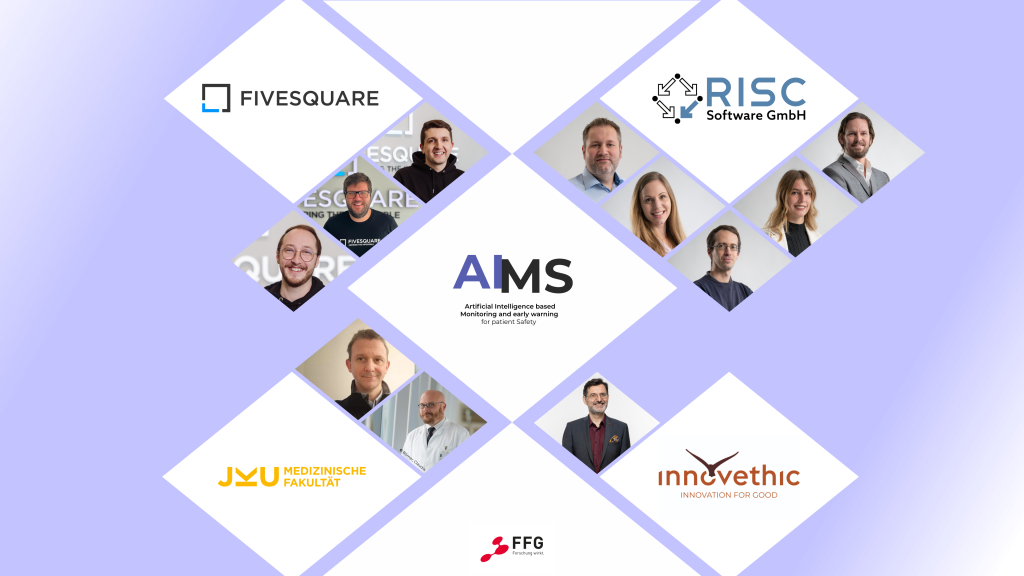
This project is funded by the Austrian Research Promotion Agency (FFG).
Project partners
Project team
Project details
Project short title: AIMS
Project long title: Artificial Intelligence based Monitoring and early warning for patient Safety
Project partners:
RISC Software GmbH (consortium management)
FiveSquare GmbH
innovethic e.U.
Johannes Kepler University Linz, Faculty of Medicine, Department of Anesthesiology and Surgical Intensive Care Medicine