Virtual Aneurysm: Simulation, Training and Assessment of Neurosurgical Interventions
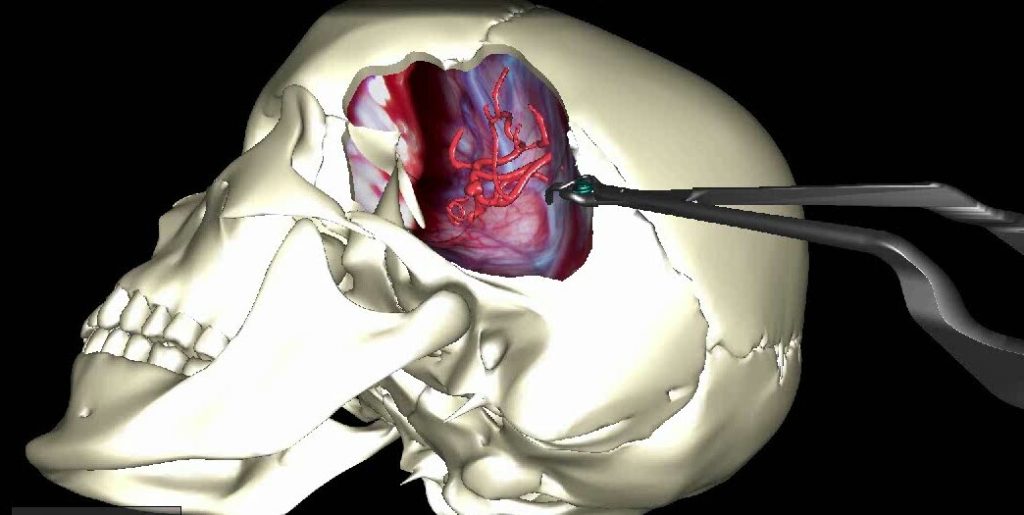
Disorders of blood circulation in the brain, such as strokes and cerebral haemorrhages, are among the most common causes of death in western industrialized countries. Intracranial aneurysms, a major cause of bleeding, can basically be treated using two strategies. In the minimally invasive, endovascular method (coiling), a catheter fills the aneurysm with a wire coil. In the neurosurgical method (clipping), doctors open the skull and place titanium clips on the artery so that the aneurysm is cut off from the bloodstream.
Simulator for training clipping operations
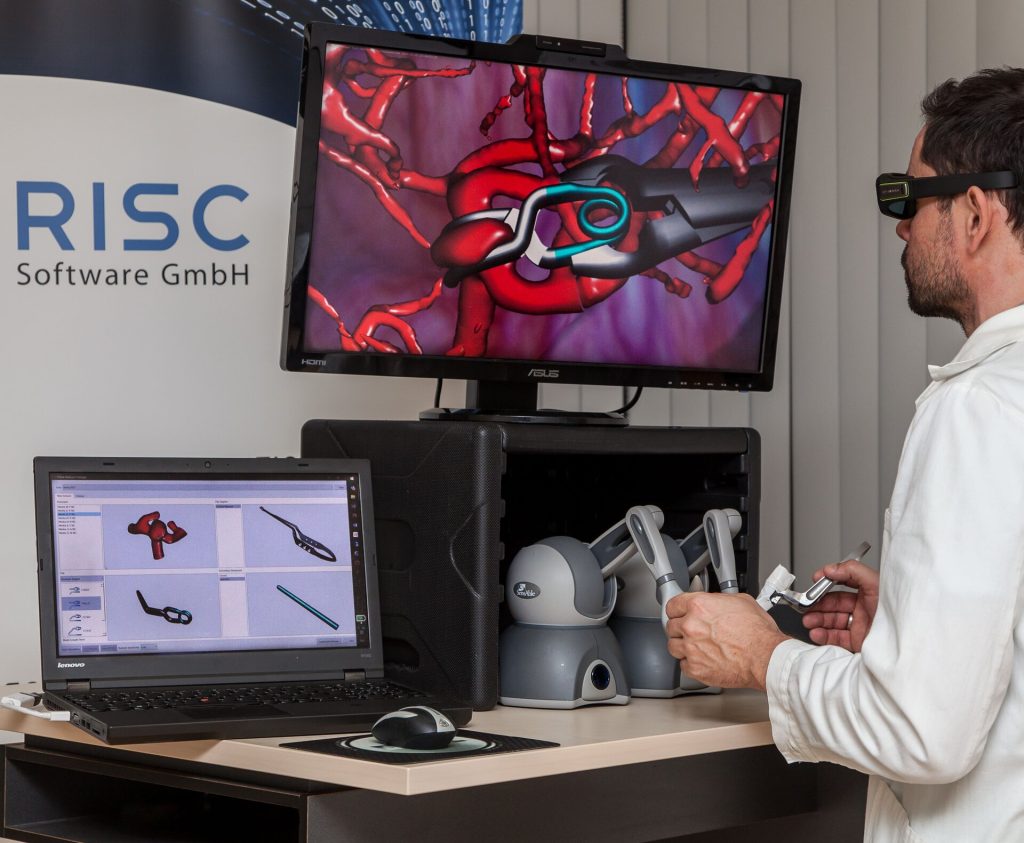
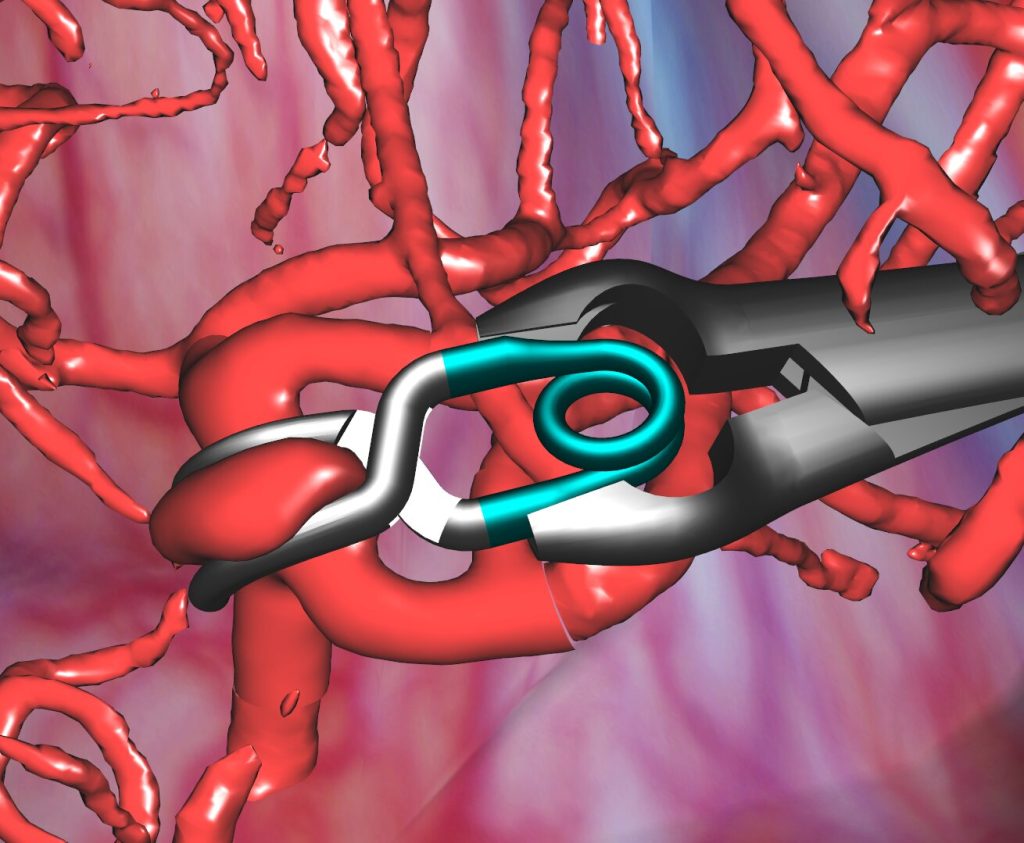
As the endovascular procedure is increasingly used for simple aneurysms, clipping remains almost exclusively for complex aneurysms. This makes it more difficult for trainee neurosurgeons to find simple situations in which they can develop their expertise for complex cases. The VIRTUAL ANEURYSM surgical simulator from the Medical Informatics research department provides a remedy here. It enables the training of clipping procedures in various virtual scenarios. The system combines two haptic input devices with force feedback and a stereoscopic display. There are also several aneurysm geometries with varying degrees of difficulty to choose from. Users can also choose from a list of over 50 3D-modeled clips of different sizes and shapes.
At the beginning of the training, the users practise the correct head positioning and the optimal positioning of the craniotomy for the respective case. During the clipping operation, the simulator continuously detects collisions between instruments and tissue and reacts immediately. At the same time, an optimized finite element method on the GPU calculates the realistic deformation of the blood vessels in real time and visualizes them. The system transmits the resulting forces to the haptic devices so that the user can feel the resistance of the tissue. Clipping forceps with an integrated sensor measure the opening angle and transmit it to the simulator in real time. Depending on the degree of difficulty, a rupture can also occur. In this case, the surgeons must stop the bleeding within a specified time and treat the burst aneurysm.
Objective training evaluation
After completing the training, users view their results from all angles. To achieve an objective assessment, the system calculates the blood flow through the artery with the aneurysm clamped. This makes it possible to estimate the induced stenosis and the residual flow into the aneurysm, among other things. These values are incorporated into a final evaluation scheme. The system also saves all training data for each user. This allows the results to be visualized and compared at any time.
Promotion and cooperation
The state of Upper Austria and the FFG funded the project as part of the BRIDGE program. The partners were the Kepler University Hospital Linz (Neuromed Campus and Med Campus III, formerly AKH Linz) and the German medical technology manufacturer Aesculap AG, world market leader for hand-held surgical instruments. These research results formed the basis for the subsequent MEDUSA project.
This project was funded by the province of Upper Austria and the FFG as part of the BRIDGE program.
Project details
- Project short title: Virtual Aneurysm
- Project long title: Virtual Aneurysm: Simulation, Training and Assessment of Neurosurgical Interventions
- Project partners:
- RISC Software GmbH, Medical Informatics Research Department (consortium leader)
- Kepler University Hospital Linz, Department of Neurosurgery
- Oberösterreichische Gesundheitsholding GmbH (OÖG)
- Aesculap AG
- Funding call: Bridge – 16 Call for proposals (FFG)
- Budget volume (total): EUR 355 thousand
- of which funding (total): EUR 213 thousand
- Duration: 01/2013 – 06/2015
Read more