MEDI-DOK: Medical efficiency through digital intelligent document analysis
The research project MEDI-DOK (Medizinische Effizienz durch Digitale Intelligente DOKumentenanalyse) aims to make unstructured text data from intensive care processable by machine.
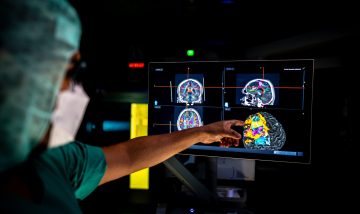
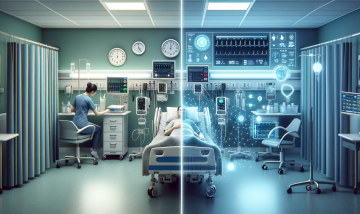
generated with AI
In intensive care medicine, a lot of structured data is collected that can be used for predictive models. Valuable information in unstructured free-text documentation remains unused. These contain essential treatment details that were previously impossible to analyze automatically. The development of large language models (LLMs) could make this data usable by machine, improve patient safety and reduce the workload for medical staff.
Goals and solutions
MEDI-DOK pursues two goals:
Improved prediction of relocation reliability through integration of unstructured text data
Reduction of manual (report creation) effort through LLM-generated text modules
These use cases are intended to improve the quality of clinical decisions and the efficiency of documentation.
Innovation content
MEDI-DOK uses advanced LLMs to harness unstructured text data in intensive care medicine. This method is a breakthrough as it incorporates untapped data sources into prediction and enables more accurate prediction of transfer safety. At the same time, the automated generation of reports by LLMs supports medical professionals by significantly reducing the documentation effort and improving the quality of treatment.
The project also examines the legal framework for the use of AI in medicine. The legal assessment creates clarity in an area that has been little regulated to date and paves the way for the legally compliant use of such technologies in practice.
Consortium
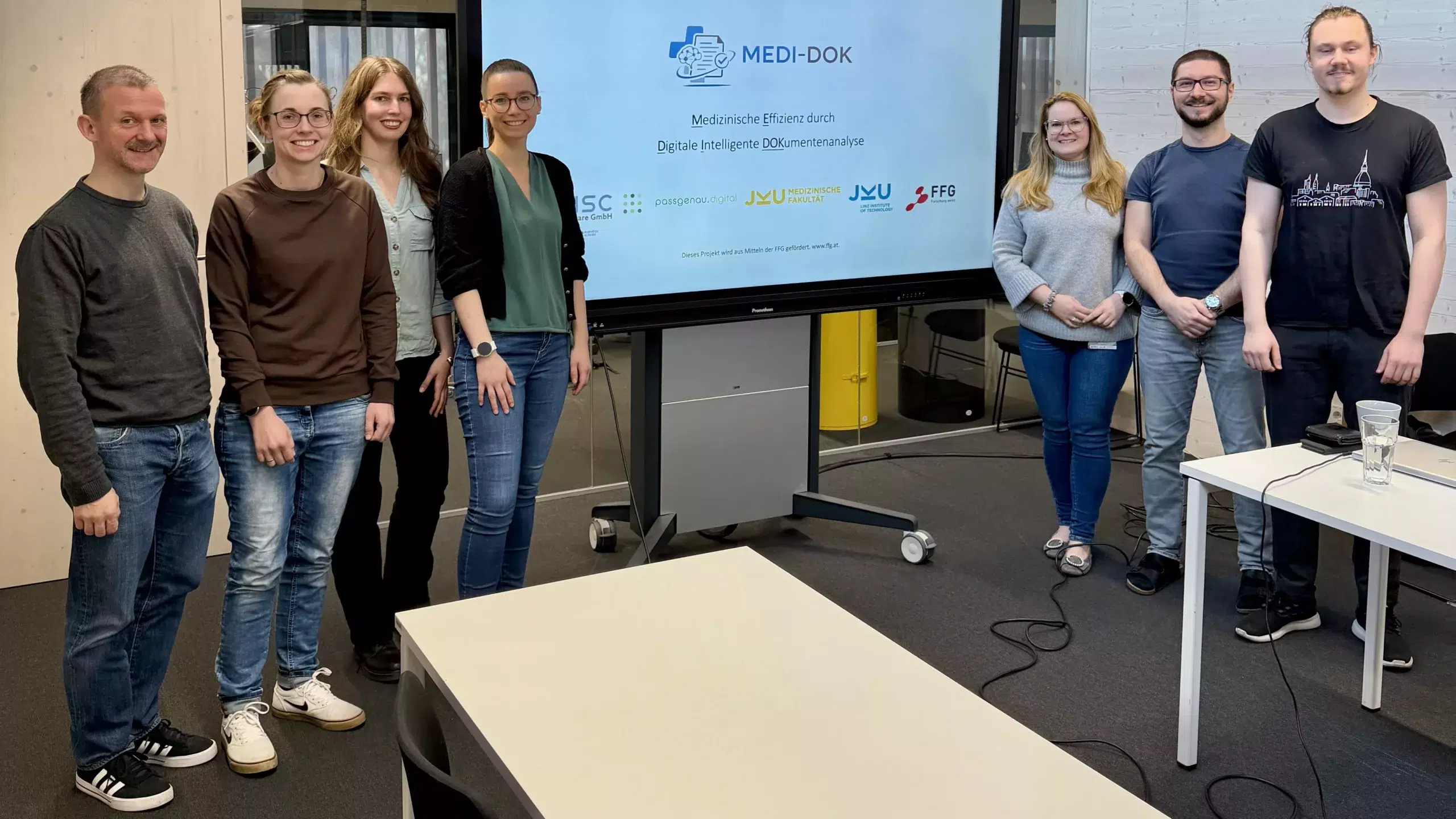
MEDI-DOK is being carried out by an interdisciplinary consortium that combines expertise from the fields of AI, medicine and law. RISC Software GmbH is coordinating the project and, in addition to Passgenau Digital, is contributing extensive experience in the development of AI algorithms. The JKU’s LIT Law Lab is investigating the legal aspects, while the JKU’s Faculty of Medicine is providing practical data and use cases.
from left to right: Thomas Tschoellitsch, Verena Praher, Sophie Kaltenleithner, Sandra Wartner, Anna Kass, Rudolf Albu, Jonas Heschl
Benefits and utilization potential
MEDI-DOK has the potential to significantly improve the quality of patient care through the integration of unstructured data. Improved predictive models could increase transfer safety, while automated transfer reports reduce the workload for physicians and improve treatment quality. The research results can help to set new standards in clinical documentation and predictive medicine. The legal analysis of the project also facilitates the future legally compliant implementation of such systems.
Sustainability and social contribution
MEDI-DOK contributes to the optimization of medical processes and promotes the efficient use of resources in the healthcare system. By avoiding redundant examinations and improving the quality of documentation, the project will contribute to more sustainable and safer intensive care medicine. The consideration of gender and diversity aspects promotes the development of equitable and inclusive technologies in the healthcare sector.
This project is funded as part of the #upperVISION2030 economic and research strategy of the state of Upper Austria and by the Austrian Research Promotion Agency (FFG).
Project partners
Project details
Project short title: MEDI-DOK
Project long title: Medical efficiency through digital intelligent document analysis