Visualization or illusion: the underestimated role of data preparation
Data quality as the foundation for reliable decisions
from Marco Jahn
Efficient corporate management requires a reliable database. However, in many companies, management decisions are still based on manually created reports, which are often contradictory or already outdated. If the data is not prepared properly, even the best visualization does not provide well-founded insights, but rather distorted results. A high coordination effort often ties up valuable resources because there is no uniform view of the key figures. Instead of pursuing strategic goals, managers spend their time clarifying the data situation. Find out in this article how professional data structuring improves the quality of decision-making and creates the basis for modern business intelligence.
Contents
When decisions cost more time than they create
Why this problem is particularly critical today
The role of the database for well-founded decisions
Why many business intelligence solutions fail despite modern tools
The role of the database for well-founded decisions
Requirements for effective decision support
From data preparation to usable decision support
Power BI as a technical basis for decision support
Economic benefits and ROI of structured data preparation
When decisions cost more time than they create
In many companies, management decisions are based on manually created reports from different departments, if decisions are made on the basis of data at all. These reports are often outdated or contradictory in terms of content by the time decisions are made, as they are based on different data statuses, definitions and calculation logics. In addition, in many cases the underlying data is not prepared for reporting and analysis purposes, resulting in distorted, incomplete or meaningless results.
The resulting coordination effort ties up valuable time and delays decisions, while there is no reliable and uniform view of the company data. Instead of strategic control, the focus is often on clarifying the data situation, which noticeably impairs transparency, speed and decision-making quality.
Why this problem is particularly critical today
Due to the increasing amount of data, companies are faced with the challenge that well-founded data-based decisions are becoming increasingly difficult to implement. If this complexity is not mitigated by suitable technical structures and consistent data processing, management loses its ability to control. Companies then run the risk of no longer acting proactively, but merely reacting to market and business developments.
The role of the database for well-founded decisions
A sound basis for decision-making is not only created in reporting, but also in the systematic technical preparation of the data. Even if the immediate added value of this step is often not directly visible at management level, it is decisive in determining whether analyses can be used consistently, reproducibly and reliably. In practice, relevant information comes from a large number of different systems, which become confusing without technical integration and functional modeling, causing reporting and analysis applications to lose their informative value.
Requirements for effective decision support
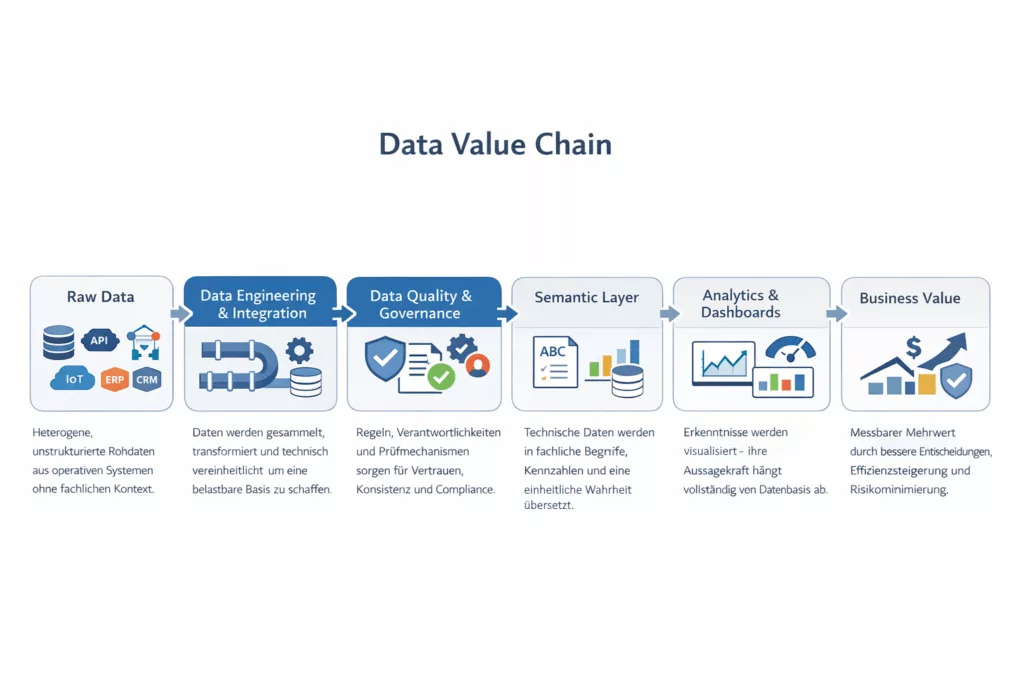
Effective decision support does not come from individual reports or visualizations, but from technically consistent processing and provision of relevant data. Managers need up-to-date and comprehensible information that is based on standardized data logic and is comparable across different use cases. Only when this technical basis has been created can dashboards reliably depict deviations, developments and correlations and serve as a genuine decision-making aid.
Why many business intelligence solutions fail despite modern tools
Many BI initiatives fail not because of a lack of visualizations, but because of inadequate technical implementation in advance. Data is brought together from different systems without being consistently integrated, technically modeled or prepared for repeatable analyses. This results in dashboards that display figures but are neither comparable nor well-founded and therefore quickly lose acceptance. Without properly implemented data preparation, business intelligence remains an isolated application instead of establishing itself as reliable decision-making support in day-to-day operations and strategy.
From data preparation to usable decision support
Only structured and technically sound data preparation makes it possible to use data permanently and consistently for reporting and decision-making purposes. This includes the integration of different data sources, the standardization of technical definitions and the development of a stable data model that works reliably even with growing data volumes. On this basis, dashboards are not created as one-off visualizations, but as reusable, resilient applications that make changes in the business transparent and support decisions in a comprehensible manner.
Power BI as a technical basis for decision support
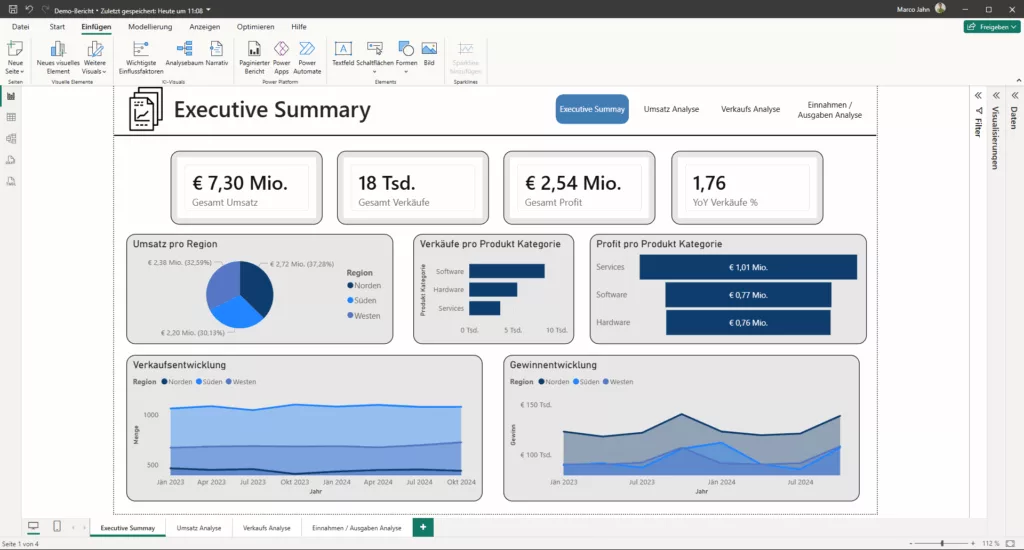
Power BI does not develop its added value as an isolated visualization tool, but as part of a technically clean data architecture. In combination with structured data preparation, it makes it possible to provide consistent data models for different use cases and to analyze them flexibly. Dashboards are therefore not static reports, but interactive applications based on stable data logic that provide decision-makers with a reliable, up-to-date view of relevant key figures.
Economic benefits and ROI of structured data preparation
The economic benefits of business intelligence arise less from the tool used than from the quality and reusability of the underlying data preparation. Technically sound integration and modelling reduces manual reporting work, minimizes sources of error and noticeably shortens decision-making cycles. At the same time, data models and dashboards that have been set up once can be reused for different issues, which means that investments not only pay for themselves in the short term, but also make a lasting contribution to increasing efficiency and improving the company’s ability to control itself.